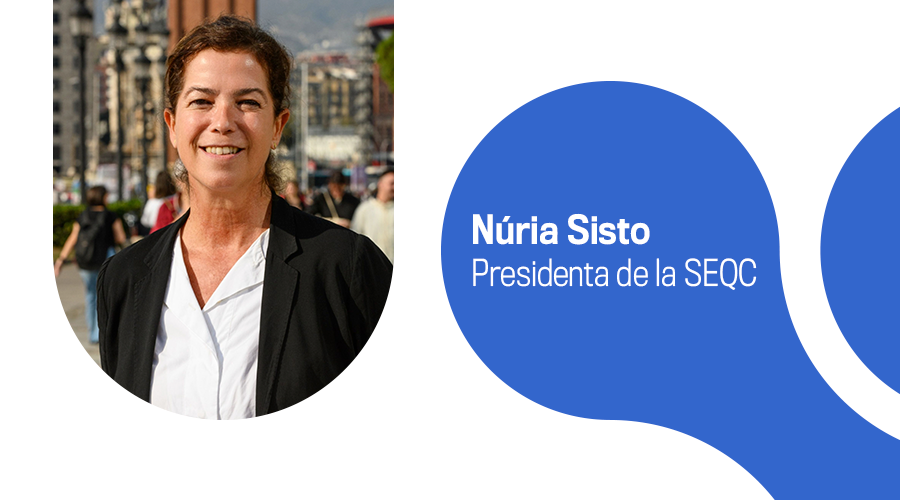
Interview with Núria Sisto, president of the Spanish Society of Cosmetic Chemists (SEQC)
The cosmetic chemistry field is undergoing significant evolution driven by sustainability, new regulatory models, and scientific innovation. Núria Sisto, president of the Spanish Society of Cosmetic Chemists (SEQC), examines the challenges and opportunities within the sector and highlights the importance of Expoquimia 2026 as a key meeting point to access new technologies, anticipate trends, and connect science, industry, and innovation.
The cosmetics sector is experiencing a moment of strong transformation in sustainability, regulation and development of new ingredients. From your position at the head of the SEQC, what would you say are the main needs and priorities of cosmetic chemistry professionals in Spain today?
From my position at the head of the SEQC, I identify several clear priorities for cosmetic chemistry professionals in Spain:
- Continuous and specialised training, especially in sustainability, safety and regulation, in an increasingly demanding and changing regulatory context.
- Regulatory anticipation capacity, which allows product development to be adapted without losing competitiveness or scientific rigour.
- Access to proven technical knowledge, based on scientific evidence and real good practices in the sector.
- Spaces for professional exchange, where experiences, challenges and solutions can be shared between industry, suppliers, consultants and academia.
- Today, professionals need practical tools to innovate safely and with a long-term vision.
In a context where innovation accelerates thanks to biotechnology, advanced materials and digitalisation, what expectations does the SEQC have regarding Expoquimia 2026 as a platform to identify new solutions and connect with key agents in the chemical ecosystem?
For the SEQC, Expoquimia is a relevant event for the sector because it offers a broad vision of the entire chemical and industrial ecosystem. It allows the identification of applicable technological solutions, not only in ingredients, but also in processes, analytics, quality control and digitalization. It facilitates contact with key agents in the chemical ecosystem, expanding the formulator’s vision beyond their usual environment. It offers an ideal environment to detect cross-cutting trends that will end up impacting all sectors. We hope that it will be a space for real connection between science, industry and innovation.
Sustainability and product safety remain two central axes for the cosmetics industry. What specific challenges does the sector face in areas such as ingredients, traceability or regulatory compliance?
The main challenges facing the sector are concentrated in several key areas:
- Ingredients: selection of more sustainable, safe raw materials with sufficient scientific support.
- Traceability: the need for an increasingly transparent and well-documented supply chain.
- Regulatory compliance: constant adaptation to regulatory changes that affect both ingredients and claims, labeling and safety assessment.
- The challenge is not only to comply with the regulations, but to do so efficiently, coherently and in line with consumer expectations.
Expoquimia brings together representatives from very different fields – basic chemistry, materials, pharmaceutical process, analytics, engineering and industrial digitalisation – in the same space. How can this transversality bring real value to cosmetic chemicals, both at the level of formulation and processes, quality or industrial scale-up?
This transversality brings a very tangible value to all of us who are dedicated to cosmetic science:
- In formulation, it allows us to learn about new materials, methodologies and scientific approaches applicable to product development.
- In processes and scale-up, it facilitates contact with engineering and production solutions that improve efficiency and reproducibility.
- In quality and analytics, it opens the door to more advanced control and validation technologies.
- Cosmetics is a deeply interdisciplinary sector, and these environments help to integrate all the pieces of industrial development.
Looking at the medium term, what scientific or technological advances do you think will most profoundly transform cosmetic chemistry in the next decade, and how should companies and formulators prepare to incorporate them?
In the next decade we will see profound transformations driven by:
- Biotechnology applied to ingredients and processes.
- Digitalization and artificial intelligence, especially in product formulation and development.
- New analytical and predictive modelling tools.
- New generation sustainable ingredients, with less environmental impact. To prepare, companies and formulators will need to invest in specialized training, foster collaboration with research centers, and take an open, multidisciplinary view of cosmetic development.
What role does SEQC Expoquimia play as a meeting point to strengthen the scientific and professional community of the cosmetics sector, and why is it important for the sector to be present at this type of event?
For the SEQC, Expoquimia is a fundamental meeting point to strengthen the scientific and professional community of the cosmetics sector, since these events allow knowledge and experiences to be shared, to generate collaboration networks between professionals and companies, and to give visibility to the essential role of cosmetic science within the chemical industry as a whole. In this sense, the active presence of the sector at this type of fair is key to promoting innovation, attracting talent and continuing to position cosmetics as a strategic scientific discipline for the future.