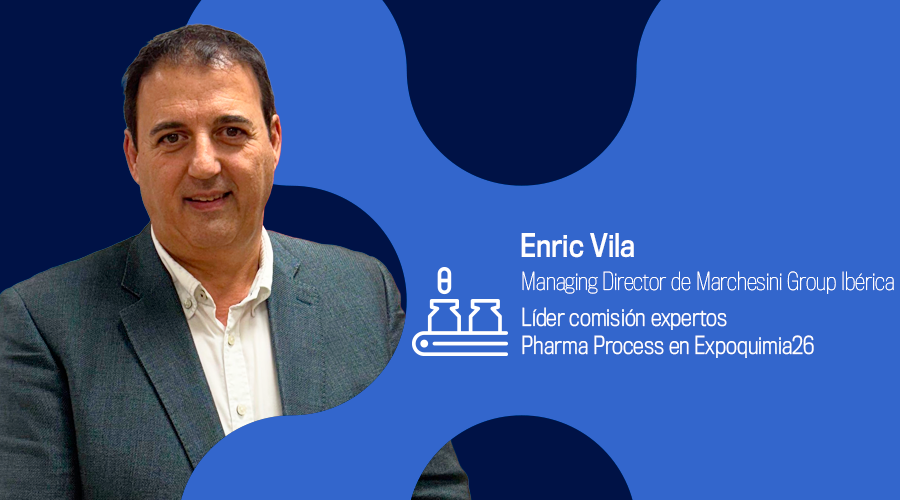
Interview with Enric Vila, leader of the Pharma Process expert committee at Expoquimia 2026
Enric Vila, Managing Director of Marchesini Group Ibérica, has led Expoquimia’s Pharma Process expert committee since it was set up a year and a half ago. This working group is made up of a dozen companies, people and key entities from the ecosystem that meets to share their vision of the market and contribute their technical knowledge, essential to continue promoting more efficient, safe and sustainable processes in the production plants of the pharmaceutical industry. In this interview, Enric Vila highlights the role of the sector in the process industries, and how it will gain prominence in the next edition of Expoquimia.
What is the essential contribution of the Pharma Process sector to the process industries and, in particular, to the pharmaceutical and biotechnology sector?
The Pharma Process sector provides the industry with a series of technologies that guarantee quality, safety and traceability in the manufacture and production of medicines in their initial phase, leaving the product ready for the next phase of the packaging flow.
What major challenges has the sector set itself?
The main challenges are common to the entire industry around us. Firstly, the digitalisation of processes: we are in an environment of constant progress in digital technologies and we must be able to integrate them into all phases of the production process to achieve an improvement in the efficiency, traceability and quality control of the products produced.
The second challenge we face is that of industrial sustainability, which has become a strategic axis in the pharmaceutical industry, driven by environmental regulations and the social demand for responsible processes.
How has the Pharma Process market evolved in Spain in recent years?
This market has taken off in our country, and an example is Expoquimia itself, in which the Pharma Process will enjoy its own space with a very qualitative offer of the market, where manufacturers and related sectors will coincide to give visibility to the sector. At the same time, investment in automation and sustainability has increased, a sign of the direction the industry is heading.
In this scenario, Spain is positioned as a hub for innovation in pharmaceutical processes, with a strong presence of manufacturers, engineering companies and R+D centres.
What kind of initiatives are needed by manufacturers, engineering companies and solution providers to promote more efficient, safe and sustainable processes?
Actions to meet the challenges faced by the process industry involve collaboration between manufacturers and technology centres, which is essential to accelerate innovation and adapt solutions to real market needs.
The adoption of GMP standards and industry 4.0 technologies also go in the direction of the actions to be taken to promote processes that guarantee quality, traceability and efficiency in highly regulated environments.
Specialized training in regulated processes is another necessary initiative, as it is a critical factor in operating, maintaining, and validating machinery in pharmaceutical and biotechnology environments.
Finally, it is essential to invest in eco-efficient and recyclable machinery, because sustainability is an unavoidable challenge for the industry. It is necessary to reduce the environmental impact without compromising the quality or safety of the product.
How do you assess the evolution of Pharma Process within Expoquimia and its impact as a reference platform for the pharmaceutical sector in southern Europe?
Expoquimia 2026 marks a turning point by creating for the first time an exclusive environment for Pharma Process. In this sense, the fair is presented as a factor to be taken into account in the presentation of Pharma Process as a strategic sector focused on innovation and sustainability, promoting an environment of international cooperation by bringing together manufacturers and customers from all over the world.
In addition, it has become a benchmark event for southern Europe, as evidenced by its attendance and exhibition figures.
The Pharma Process sector gains prominence at Expoquimia26. What arguments would you use to convince the head of a pharmaceutical plant that a visit to the salon is going to be beneficial to you?
At Expoquimia, a wide range of technological solutions and state-of-the-art equipment will be exhibited to ensure that our customers operate with maximum efficiency in an increasingly competitive market. Just the opportunity to concentrate and compare so much knowledge in several days, I think is already remarkable. In addition, the fair is working on a programme of conferences and specific content for this group by leaders of the pharmaceutical ecosystem itself. In short, a sectoral meeting point is being built.
One of the axes of the event is the collaboration between industry, science and technology. What role do you think public-private partnerships and international cooperation play in the development of the pharmaceutical sector?
The joint work between industry and the public environment is especially important in achieving the challenges we face.
The financing of R+D projects is a crucial point in which public-private partnerships are essential in the promotion of new solutions both in the Pharma Process environment and in others. Through participation in public programs, which finance collaborative projects between industry and science; with strategic consortia between manufacturers, universities and technology centres; in private investment, through startups and spin-offs with disruptive solutions in digitalisation or sustainability.
The Expoquimia commission that he leads has been created to detect synergies, make trends visible and accelerate innovation in all links of the pharmaceutical process. Have you been able to draw any conclusions after the first meetings?
The first meetings of the Pharma Process committee at Expoquimia have been especially revealing. One of the clearest conclusions is the need to move towards a real integration of the entire pharmaceutical industry in a transversal key. This involves connecting all actors – from the galenic laboratory to industrial production, quality control, cleaning, packaging and traceability – to build a network of solutions that brings tangible value to visitors.
The aim is for all areas of action of a pharmaceutical plant to feel represented at Expoquimia, not as watertight compartments, but as parts of an interconnected ecosystem. In this sense, Pharma Process is consolidated as a specific space within the fair, a link that makes this industry visible and that allows professionals to identify synergies, share challenges and accelerate innovation.
What key themes or trends have been identified as priorities for the pharmaceutical industry in the field of manufacturing and processing? What are the main strategic lines that you have proposed to follow?
Continuous manufacturing, sustainable processes, digitalisation and traceability, and the design of flexible plants stand out. These priorities respond to an industry that needs to be more agile, efficient and respectful of the environment. To this end, the strategic lines we propose to follow include promoting interoperability between teams, promoting specialized technical training and fostering collaboration between industry, science and technology.
Expoquimia 2026 will undoubtedly be the starting point to consolidate this transversal vision of the Pharma Process, and from the commission we work so that each actor in the sector –whatever their speciality– finds their space, their interlocutor and their opportunity for growth here.