

The move towards smarter, more connected and more autonomous plants is already part of the chemical industry’s roadmap. However, the path towards this goal still poses significant challenges relating to data quality, technological integration, people’s training and the sheer complexity of industrial processes. These were some of the main conclusions of the round table organised by the magazine Automática e Instrumentación, as part of Expoquimia.
Experts from ISA, Rockwell Automation and Endress+Hauser discussed the current state of technologies such as artificial intelligence, Digital Twin and advanced automation, as well as the opportunities and barriers shaping their adoption in the chemical industry.
The digital transformation of the chemical industry is advancing at different speeds, but in an increasingly clear direction. Advanced automation, artificial intelligence, data analytics, predictive maintenance and digital twins are now part of the everyday vocabulary of many process plants. The question is no longer so much whether these technologies will be adopted, but how to do so efficiently and safely in order to generate real operational value.
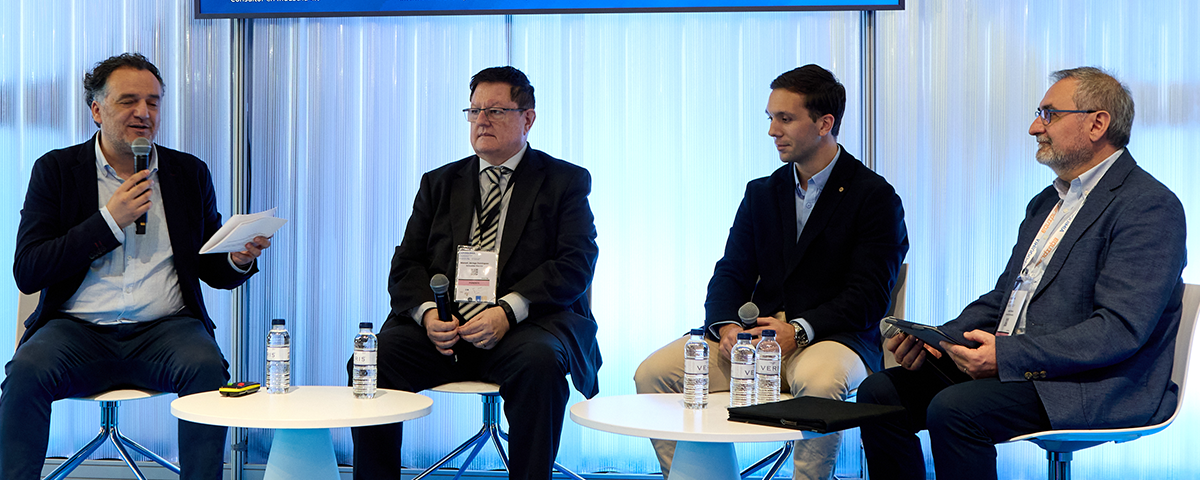
With the aim of examining this scenario, Automática e Instrumentación organised the round table ‘From the smart plant to the autonomous plant: advanced digitalisation, AI/ML and Digital Twin for operational excellence in the chemical industry’ at Expoquimia 2026, moderated by Javier Garcia Calvo, a consultant in Industry 4.0. It was joined by Manuel Járrega, Board Member for Engineering and External Communications at the Spanish Section of ISA; Antoni Rovira, Software and Control Manager at Rockwell Automation Iberia; and Marc Esteve, Product Manager for Digitalisation & Temperature at Endress+Hauser.
For Manuel Járrega, there is still a long way to go. “Although digitalisation has become a strategic priority for many companies, the practical rollout of these technologies is still at a relatively early stage,” he noted.
The shared conclusion was clear: the chemical industry has set out on this path, but there is still considerable room to grow before it can make the most of the full potential of these technologies.
To access the full feature, see issue 570 of the magazine Automática de Instrumentación