

Engineers Day, held on 4 June 2026 as part of Expoquimia, aimed to highlight the strategic role of engineering in the modernisation and transformation of the chemical industry. The European and Spanish chemical industries face significant challenges in competitiveness, sustainability and strategic autonomy, which call for investment, new technologies and transformation projects in which engineering plays an essential role.
Jointly organised by Expoquimia and the Col·legi d’Enginyers Industrials de Catalunya (EIC, the Association of Industrial Engineers of Catalonia), the event set out to showcase real projects and solutions already available, connecting technological innovation, market needs and the challenges facing society. For the Col·legi d’Enginyers Industrials, it was also an opportunity to raise the profile of the profession and to champion engineers as agents of industrial transformation. The event brought together four leading national and international engineering and technology companies — Schneider Electric, Sener, Technip Energies and Técnicas Reunidas/Track — who shared concrete experiences from different perspectives and sectors.
The Spanish and Catalan chemical industry facing a demanding scenario
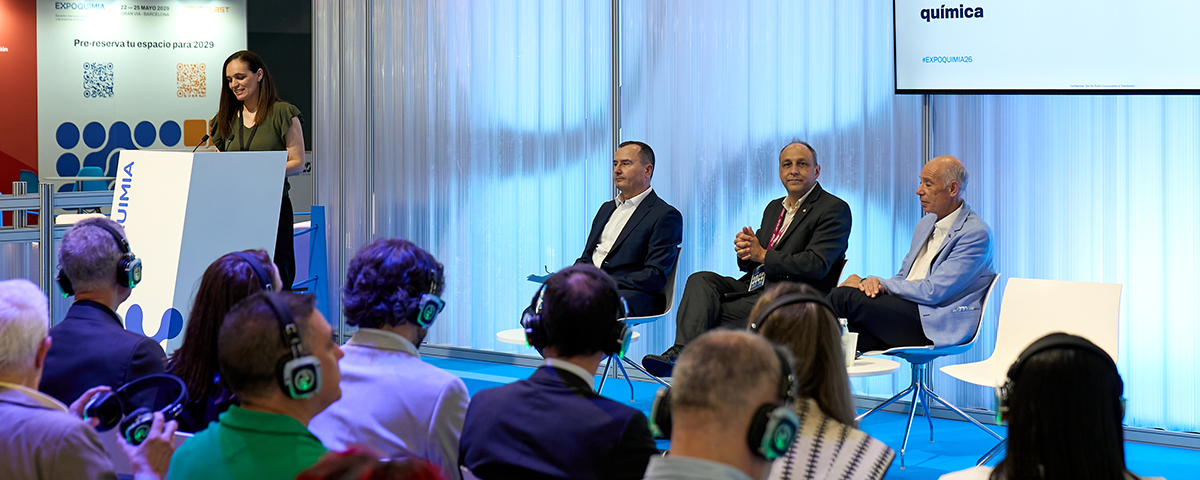
The opening session featured Pere Condom, Head of the Strategic Analysis Area at the Directorate-General for Industry of the Catalan Government (Generalitat); Manel Torrent, Chair of Committees at the Col·legi d’Enginyers Industrials, and Xavier Pascual, Director of Expoquimia.
Condom put the weight of the chemical sector in Catalonia into context and noted that the European chemical industry is going through a particularly demanding period due to competition, high energy costs and the difficulty of developing sustainable products when sufficiently consolidated demand does not yet exist. Against this backdrop, he identified the sector’s main priorities and opportunities. Manel Torrent stressed that the demands of the European Union and the market are, at the same time, an opportunity for engineering, since the profession can provide concrete solutions while always factoring in safety. Xavier Pascual highlighted Expoquimia as a space for sharing knowledge, driving research and innovation, anticipating challenges and showcasing people and talent.
Projects and solutions for a low-emission industry
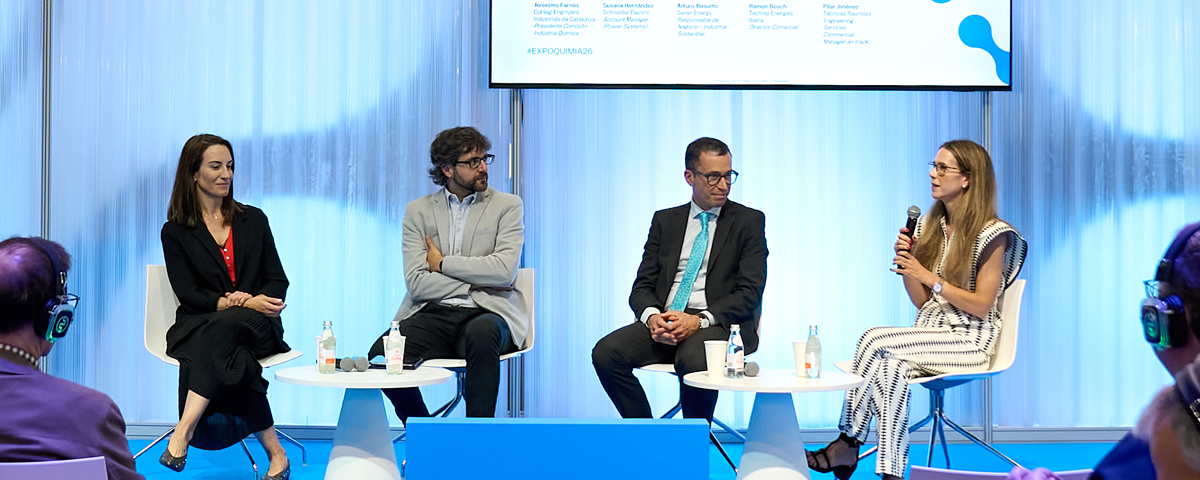
The presentations given by the engineering firms showed that transformation is not possible with a single technology, but instead requires a combination of different solutions and technologies, including: energy efficiency, electrification, new energy vectors, circularity, the production of sustainable, emissions-neutral fuels and products, digitalisation, and the adaptation of existing facilities.
Susana Hernández Moreno, Account Manager at Schneider Electric, focused her talk on digitalisation and efficiency in an energy-intensive sector. She explained how digital twins make it possible to optimise plant design, reduce errors during execution and cut down on cabling, while monitoring and advanced management can reduce CO₂ emissions and energy consumption. Automation, data and artificial intelligence are enabling a move towards more autonomous and predictive operations, simultaneously improving performance, flexibility and environmental footprint.
Arturo Basurto Arana, Head of Sustainable Industry Business at Sener, pointed out that there is no one-size-fits-all solution for industrial transition: each facility needs its conditions analysed and different technologies combined. Through six use cases, he showed the practical application of these solutions, including an energy efficiency project designed specifically for a Spanish plant. His talk highlighted the need to approach the transition from a comprehensive engineering and infrastructure perspective.
Ramon Bosch, Commercial Director at Technip Energies Iberia, addressed the evolution of the markets and the design of new chemical plants. He highlighted the growing role of electricity and new energy vectors and argued for circularity as a fundamental element in the transformation of the chemical industry. In this context, he stressed the value of waste as a raw material and cited Repsol’s Ecoplanta as an example, designed to convert 400,000 tonnes of waste into methanol. He also noted that energy autonomy requires combining different technologies and warned of the need for a decisive European push to advance the energy transition.
Pilar Jiménez Domínguez, Engineering Services Commercial Manager at Técnicas Reunidas/Track, closed the presentations with a focus on engineering services and the deployment of clean technologies in real industrial facilities. She highlighted the profound transformation the chemical industry has undergone over the last decade and the simultaneous need to remain competitive, decarbonise and transform existing assets. Her conclusion reinforced an idea shared throughout the day: engineering companies have a fundamental role to play in turning transformation goals into deliverable projects.
Recognition for the AEQT and networking
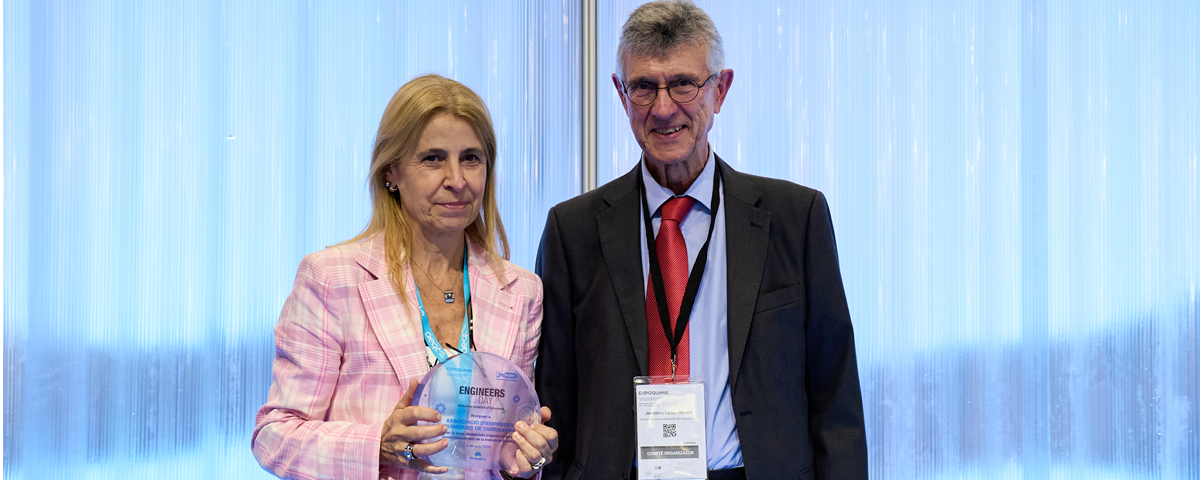
One of the highlights was the presentation of the Engineers Day recognition award to the Asociación Empresarial Química de Tarragona (AEQT, the Tarragona Chemical Business Association), in recognition of its continued work since 1977 and its contribution to industry, the economy and society. Jeroni Farnós, Chair of the Chemical Industry Committee at the Col·legi d’Enginyers Industrials and coordinator of Engineers Day, highlighted the AEQT’s track record in representing the sector and its contribution to making the Tarragona chemical complex an international benchmark in areas such as safety, sustainability and competitiveness. Maria Mas, Managing Director of the AEQT, described the recognition as an incentive to keep working and as a sign of a shared vision for the present and future of the industry.
Engineers Day concluded with a networking session, reinforcing its role as a meeting point between engineering, technology companies and the chemical industry.